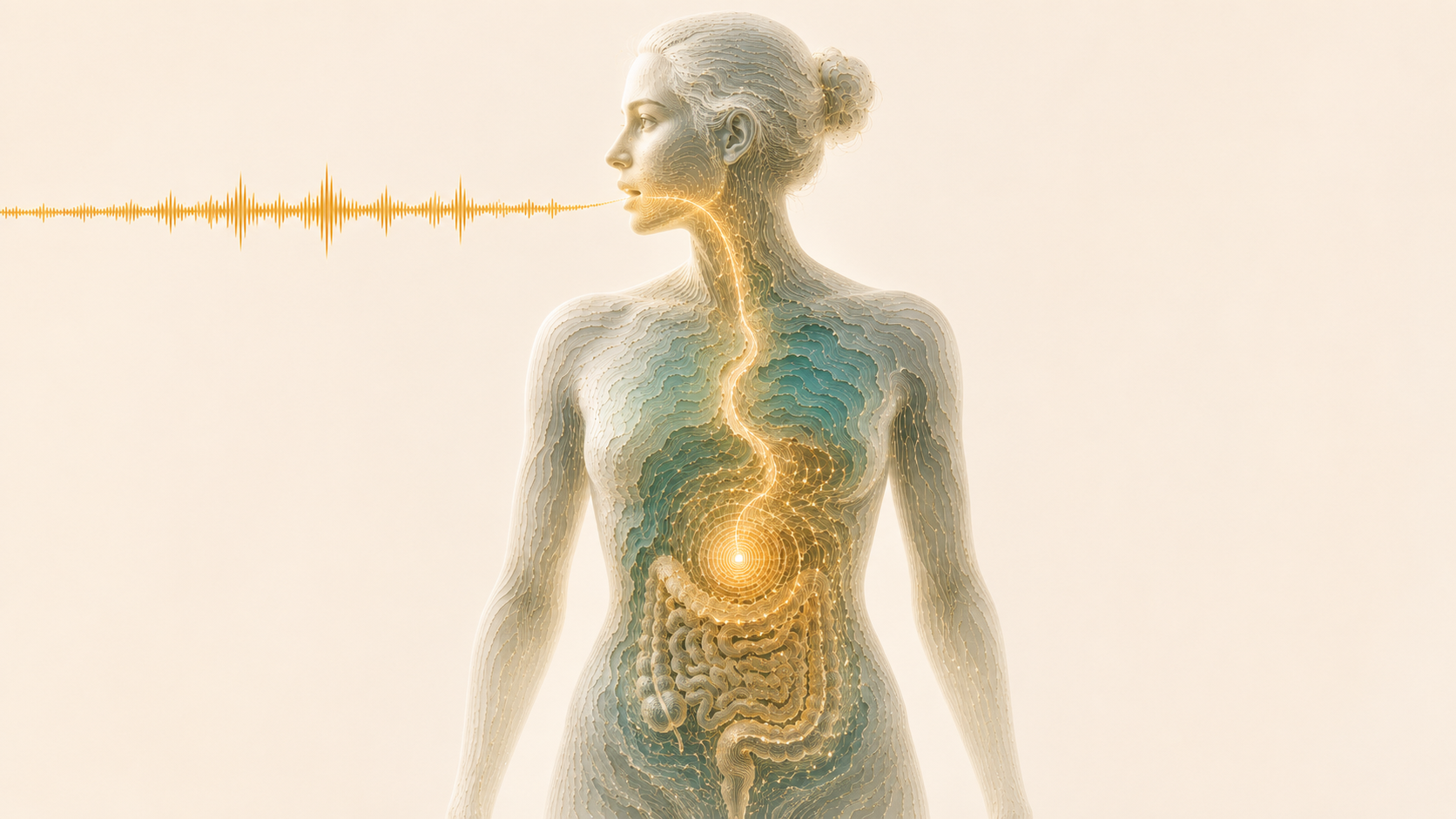
The Terrain
The terrain is the interior landscape of the body, and it governs everything.
It is not one organ, one blood test, or one label. It is the real-time, whole-body condition shaped moment by moment by food, water, stress, sleep, movement, breath, charge, and the microbial community that lives within you.
When the terrain is balanced — clear, charged, and rhythmic — the body has stronger ground for sorting, clearing, repairing, and regulating itself.
When the terrain deteriorates — overloaded with input, sluggish in clearance, electrically flat — the internal landscape shifts. The microbiome, which is highly sensitive to the terrain, changes in response.
This is the terrain principle behind pleomorphism: microorganisms are not simply fixed invaders. Their behavior, form, and function can shift with the conditions they find.
A strong terrain supports cooperative, symbiotic microbial patterns. A damaged, stagnant, low-charge terrain can invite more opportunistic patterns.
The terrain does not simply react to microbes. The microbes react to the terrain.
Everything we do at TerrainIntent — the map, the rhythm readings, the voice check-in, and the step-by-step changes — is about restoring the terrain so the internal landscape returns toward its natural self-regulating rhythm.
We do not lead by fighting germs. We change the ground they stand on.
Mapping Your Terrain
The first step is making the pattern visible.
Mapping means organizing what is happening now: your voice, energy, food rhythm, hydration, digestion, sleep, stress load, movement, recovery, and hoped outcome.
It is the first practical act of terrain reading.
Most people know they feel “off,” but they cannot always see how yesterday’s late meal, this morning’s skipped water, last week’s poor sleep, and a simmering stress load may be feeding the same loop.
The map makes these connections visible.
It takes scattered signals and places them into one coherent picture — the terrain picture.
Mapping begins with the voice check-in: your unfiltered, in-the-moment sense of how things feel.
Then it adds rhythm data: when you ate, what you drank, how you slept, how you moved, what your gut did, and where your energy landed throughout the day.
These are not judgments. They are terrain data points.
Over days and weeks, they reveal where charge is building, where clearance is lagging, where rhythm has stalled, and where the first change might be placed.
TerrainIntent mapping does not try to map everything at once. It maps enough to find the next step.
Then it maps again after that step is taken, watching how the terrain responds.
This is the rhythm of the work: map, change, observe, re-map.
The map is never finished because the terrain is alive.
But once you learn to read it, the way forward becomes a series of clear, small choices — not a guessing game.
Mapping turns the invisible interior into something you can finally see, trust, and work with.
Voice
The first signal. The whole body speaking.
Voice is the first terrain signal.
It is the unfiltered report you give when someone asks, “What are you noticing right now?”
Tight. Heavy. Foggy. Clear. Wired-but-tired. Steady. Flat. Swollen. Calm. Off.
Simple words often carry the whole pattern.
In TerrainIntent, voice is not small talk. It is the body’s first summary of the current terrain state.
Before the forms, before the scores, before the rhythm logs, the voice gives direction. It tells us how the body is experiencing itself right now.
Voice & the Body’s Systems
One voice. Many systems speaking.
Voice is not separate from the body. The words you reach for — heavy, wired, foggy, clear, swollen, flat, tense, calm, scattered, steady — carry the combined state of several systems at once.
The nervous system speaks through words like wired, tense, frozen, flat, restless, shut down, and calm.
The metabolic system speaks through crashing, steady, hungry, shaky, heavy after meals, and clear after eating.
The gut speaks through bloated, pressured, unsettled, backed up, loose, reactive, and calm.
The immune-clearance system speaks through thick, swollen, inflamed, heavy, fluey, stagnant, and clearing.
The endocrine-stress rhythm speaks through exhausted on waking, resilient, brittle, anxious, burned out, and unable to reset.
The hydration-flow system speaks through dry, puffy, tight, sluggish, light, flowing, and stuck.
The sleep-recovery system speaks through restored, unrested, wired at night, dull in the morning, and slow to recover.
A single sentence can hold nervous-system tone, metabolic rhythm, gut pressure, immune load, hydration state, sleep debt, and recovery capacity — all at once.
TerrainIntent listens to the voice first because the body speaks in whole patterns long before the mind separates them into categories.
The voice gives the direction.
The intake gives the context.
The map shows where the systems meet.
Then we choose one next step that matches the terrain as it is today.
Over time, voice becomes one of the clearest signs of change.
A person may still have the same complaint, but the voice begins to move: from drained and foggy toward clearer and steadier, from wired and tense toward settled and grounded, from heavy and stuck toward lighter and moving, from scattered toward organized.
Voice is how the terrain speaks before the mind has organized the story.
TerrainIntent does not override that signal. We listen to it. We map it. We compare it with food rhythm, hydration, digestion, sleep, stress load, movement, recovery, and the hoped outcome.
Learning to hear your own voice clearly is one of the first skills of terrain reading.
Because once you can hear the signal, you can stop guessing. You can begin working with the body as it is today.
The Orientation Compass
Not the full map. A starting signal.
Your voice check-in creates a first orientation signal.
It does not give the whole terrain picture. It points.
One reading is a snapshot.
Consecutive readings begin to show direction.
The compass works with your Terrain Context so the signal has ground to stand on: food rhythm, hydration, sleep, stress load, digestion, movement, recovery, and hoped outcome.
A compass reading may show: Current state: Scattered. Current position: South-East. Signal strength: Moderate. Trajectory: Activation leaning. Trail: Drifting outward.
The compass watches for broad terrain states such as Compressed, Scattered, Recovering, Stabilizing, and Transitioning.
Each reading adds a dot.
The earlier dot shows where the terrain was.
The current dot shows where it is now.
Together, the dots reveal whether the terrain is settling, stirring, cycling, or shifting.
A single reading is held lightly.
If the signal is weak, mixed, or noisy, we compare it with another check-in after a meaningful shift in energy, recovery, food rhythm, stress load, hydration, digestion, or sleep.
The compass does not decide the next step by itself.
It shows which way the terrain is leaning.
Then the map, the context, and the echo guide the next move.
Compass States
What the orientation signal is pointing toward.
The Orientation Compass uses five broad terrain states to describe the direction your body is leaning today.
These are not fixed identities. They are pattern states — snapshots of nervous-system tone, metabolic rhythm, recovery posture, flow, charge, and overall load.
One reading is a hint. Repeated readings reveal a trail.
Compressed
The system feels tight, held, or braced. Energy may be present, but it is not flowing freely. Digestion may feel sluggish, breathing may feel shallow, and recovery may feel slow.
The terrain is conserving. Small, gentle inputs work better than big shifts.
Scattered
Signals feel dispersed. Energy spikes and crashes. Focus wavers. Gut rhythm becomes irregular. Sleep may feel restless, light, or ungrounding.
The nervous system is responding to many inputs without a clear filter. The map helps identify which load to reduce first so the terrain can gather itself.
Recovering
The body is coming back after stress, overload, illness, poor sleep, emotional strain, or a period of depletion.
Energy is returning, but it may still feel fragile. Digestion may be settling. Sleep may be starting to restore. The terrain is receptive, but it needs rhythm protection.
This is where holding steady matters more than pushing forward.
Stabilizing
Rhythms are finding their groove. Energy becomes more predictable. Gut patterns begin evening out. Sleep starts to reset. Recovery happens with less effort.
The terrain may not be fully charged yet, but it is less reactive. This is a good time to reinforce what is working.
Transitioning
The system is moving between states. An old pattern may be loosening. A new rhythm may be trying to establish. The voice may feel mixed. The echo may wobble.
The compass shows a direction shift. During transition, the next step is often patience: read the echo, not the expectation.
Each new check-in adds another dot.
Over time, the dots reveal whether the terrain is settling, cycling, drifting, recovering, or truly shifting.
Watch the Echo
The terrain’s first response.
After one small change, the body answers.
A meal shifted. A hydration rhythm adjusted. An earlier bedtime. A calmer morning. A different food combination. A longer gap between meals. A lighter evening routine.
The response that follows is the echo.
It may show up as steadier energy, a calmer gut, clearer thinking, deeper sleep, easier bowel rhythm, less pressure, or a quieter nervous system.
It may also show up as heavier fatigue, scattered focus, stronger cravings, a gut reaction, emotional pressure, or no clear shift at all.
The echo is not a judgment. It is the next signal.
TerrainIntent watches the echo because the body is always responding to the conditions around it.
One change creates a ripple. That ripple tells us whether the terrain is opening, resisting, clearing, settling, or asking for a different next step.
This is how the work stays practical.
We do not guess. We map. We change one thing. We watch the echo. We choose the next move from what the terrain gives back.
The echo is how the living terrain teaches us what it needs next.
Microbiome & Pleomorphism
Your body is a living partnership, not a battlefield.
The gut, skin, mouth, and lungs are home to trillions of microorganisms — bacteria, archaea, fungi, and viruses.
In a strong terrain, this community lives in partnership with you. It helps digest food, produce vitamins, train immune rhythm, maintain the gut barrier, and participate in the body’s electrical and chemical exchange.
You are not separate from your microbiome.
You are a walking ecosystem, and the relationship is meant to be cooperative.
The old view says disease begins when outside germs invade a mostly sterile body.
The terrain view is deeper.
Microorganisms are pleomorphic: they can change their shape, metabolism, and behavior based on the environment they find themselves in.
A microbe that behaves as part of a balanced inner ecosystem can behave very differently when the terrain becomes stagnant, overloaded, poorly clearing, and low in charge.
It is not always that a “bad bug” arrived.
Often, the terrain shifted — and the resident microbes adapted to the new conditions.
This is why TerrainIntent does not start by waging war on the microbiome.
We do not sterilize the terrain.
We do not try to kill our way back to health.
We read the terrain: the load coming in, the clearance going out, the rhythm, the charge, the flow, and the recovery pattern.
Then we restore the conditions where symbiotic life can flourish again.
When the terrain is right, the microbes return toward partnership.
The inner ecosystem begins to restore itself.
Gut Terrain
The gut is where the body meets the world.
The gut is not a passive tube.
It is a living terrain — a charged, microbial, rhythmic landscape where food, water, breath, stress, and bacteria meet the body.
Every meal, every sip of water, every stress wave, every bowel pattern, and every microbial reaction either builds or drains the gut’s charge.
This is not just metaphor.
The gut wall is alive with structured water, charged proteins, minerals, microbes, mucus, and electrical gradients. Together, they help turn raw input into usable energy, rhythm, and repair.
The food you eat is broken down into signals.
The microbial community helps transform those signals.
Short-chain fatty acids like butyrate help feed the gut lining.
The gut lining then uses that energy to maintain barrier strength, oxygen balance, charge separation, and the rhythm of repair.
This is why the gut is central to the whole terrain.
When gut rhythm is strong, the body has better ground for energy, clarity, immunity, recovery, mood, and steadiness.
When gut charge drops — from overload, poor food rhythm, stress, stagnation, poor clearance, or disrupted microbes — the whole body feels it.
The microbial community shifts.
The bowel rhythm shifts.
The nervous system feels more pressure.
Recovery slows.
The terrain begins to feel heavy, reactive, or frozen.
To restore the body, the gut terrain has to be rebuilt.
Not by forcing it. Not by shocking it.
By feeding the chain that builds charge: better food rhythm, better hydration, better clearance, better minerals, better breath, better sleep, better microbial support, and one clear change at a time.
The gut is the generator floor.
It is where input becomes charge.
It is where food becomes rhythm.
It is where the terrain is either built or drained — one signal, one meal, one breath, one bowel rhythm, one electron at a time.
Voltage & Charge
The body is electric before it is mechanical.
Voltage is the body’s native electrical potential.
Every cell membrane holds a charge — a tiny difference in electrical tension between inside and outside. This charge is not a metaphor. It is physical.
It supports nutrient transport, muscle contraction, nerve signaling, tissue repair, fluid movement, and recovery.
When voltage is robust, the body feels clear, steady, warm, responsive, and alive.
When voltage is depleted, everything slows.
TerrainIntent uses voltage language to describe the daily conditions that support rhythm, flow, steadiness, nourishment, recovery, and readiness.
You already know the feeling of being charged: waking clear-headed, energy steady, digestion calm, mood more stable, and recovery easier.
You also know the feeling of being drained: heavy, foggy, reactive, cold, tense, slow to bounce back.
These are not just moods.
They are the lived experience of the body’s bioelectric state.
Voltage is built by what you take in — light, water, minerals, oxygen rhythm, electrons from food, and daily movement.
It is preserved by what you do not waste: poor sleep, stress overload, constant sensory pressure, shallow breathing, nutrient-poor meals, and stalled clearance.
The gut is a central generator, but every tissue contributes.
Collagen, fascia, minerals, cell membranes, and the structured water around them help form the body’s living electrical network.
This is the body’s charge field — the ground that supports flow, repair, and communication.
Rather than chasing millivolts, TerrainIntent reads the daily signals: energy after meals, sleep depth, gut rhythm, cravings, hydration, bowel rhythm, stress load, and recovery speed.
These signals show whether the terrain is charging or leaking.
TerrainIntent maps those signals, locates the voltage drains, and changes one thing at a time — so the body’s own generator can begin to hold charge again.
The goal is not a jolt.
It is a steady, self-sustaining current.
Food & Hydration Rhythm
The body reads timing as information.
Food and hydration rhythm give practical clues.
The goal is not perfection. The goal is to see what timing, combinations, liquids, and routine are doing to the current terrain picture.
Your gut expects a daily beat — regular meals, consistent hydration, and predictable gaps where the gut’s cleaning wave, the migrating motor complex, can sweep and reset.
When this rhythm is coherent, digestion, energy, bowel flow, and clearance fall into step.
When the rhythm scatters, the terrain loses its reference point.
The microbiome lives on a clock of its own. Irregular fuel often produces irregular signals: cravings, bloating, crashes, heavy digestion, and wakefulness at odd hours.
TerrainIntent reads food rhythm and hydration not as calories or ounces, but as timing information.
The body uses that timing to allocate charge, enzymes, bile rhythm, bowel movement, repair, and recovery.
We map what your current pattern is actually saying.
Then we locate where the rhythm has thinned, scattered, or stalled.
We change one variable at a time — meal spacing, liquid type, food timing, overnight fasting window, or hydration rhythm — and watch how the terrain responds.
The goal is not a perfect schedule.
It is a readable rhythm the body can trust.
When the gut knows when fuel is coming and when it can rest, the whole ecosystem settles.
From that steadiness, charge can rise naturally.
FTR — Freeze / Thaw / Restore
FTR is a simple orientation frame for complex or layered terrain patterns.
Freeze means the terrain may feel stuck, heavy, stalled, guarded, or conserving energy.
Thaw means movement has started, but it may feel uneven. Some rhythms improve while others still lag.
Restore means the pattern is becoming more organized: less scatter, more rhythm, and a clearer next move.
FTR is not a diagnosis. It is a way to describe where the terrain appears to be in the movement from stuck to more coherent.
Coherence
Coherence is when your terrain signals begin to organize into one clearer picture.
It does not mean symptom-free, perfect, or finished. It means less scatter, more rhythm, better self-awareness, and a clearer next move.
Energy, sleep, stress, digestion, recovery, food rhythm, hydration, and daily load begin to make more sense together.
TerrainIntent uses voice and context to help you notice the pattern, compare what changed, and choose the next practical move.